NBME 7
Block 1
Question 1

Colesevelam
Ezetimibe
Gemfibrozil
Niacin
Rosuvastatin
Question 2

Bronchoconstriction
Bronchodilation
Vasoconstriction
Vasodilation
Question 3

“The Intemet is a great way to leam about methods to decrease sodium in your diet"
"Do you know what kinds of foods are high in sodium?”
"Iwill send you a brochure outlining the low-sodium diet you will need to follow”
"You must see a nutritionist to discuss decreasing your sodium intake.”
"You need to lower your intake to fewer than three grams of sodium daily."
Question 4
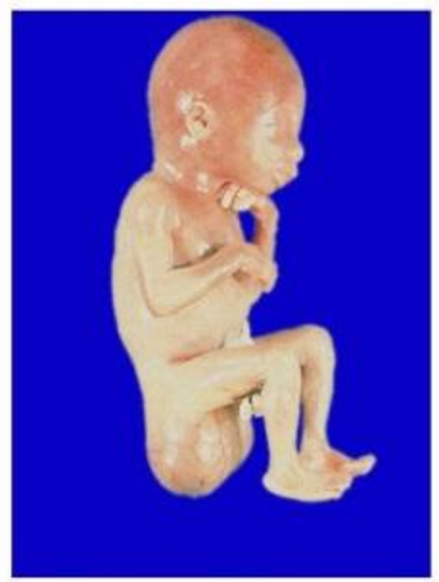
A stillborn male newborn is delivered to a 32-year-old prnmigravid woman at 36 weeks' gestation. A photograph of the newborn is shown. Histologic examination of the sacrococcygeal tumor shows a haphazard arrangement of somatic tissues representing denvatives of ectoderm, mesoderm, and endoderm. The pathogenesis of this congenital neoplasm is most ikely related to a defect arising dunng which of the following developmental processes?
Head mesenchyme proliferation
Hematopoiesis
Neural crest formation
Neural tube closure
Primordial germ cell migration
Somite development
Question 5

Amitriptyline
Buspirone
Fluoxetine
Haloperidol
Lithium carbonate
Question 6

Class | MHC molecule peptide loading
Class Il MHC molecule peptide loading
Peptide binding to T-lymphocyte receptor alpha beta
Peptide binding to T-lymphocyte receptor gamma&
Question 7

Glucokinase
Glyceraldehyde-3-phosphate dehydrogenase
Hexokinase
Pyruvate carboxylase
Triose-phosphate isomerase
Question 8

Golgi complex
Mitochondrion
Polyribosome
Rough endoplasmic reticulum
Smooth endoplasmic reticulum
Question 9

"Fortunately, medical research has led to significant advances in the treatment of dementia"
“I understand your concern. Let's talk more about your specific worries"
Question 10
Question 11
The continuous administration of gonadotropin-releasing hormone is most likely to elicit which of the following long-term changes in the release of luteinizing and folicle-stimulating hormones?Question 12

Question 13
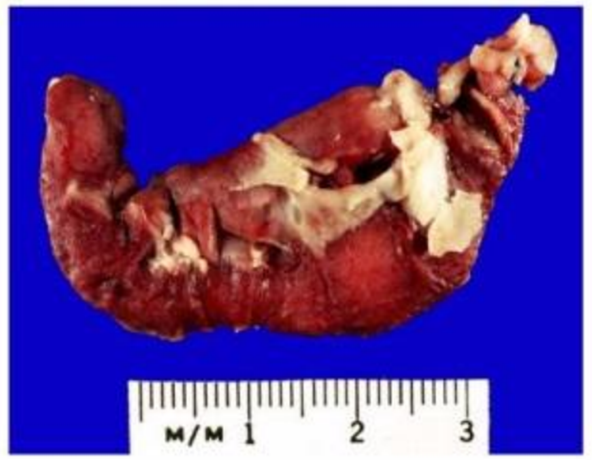
A 19.year-old woman comes to the emergency department because of nght lower abdominal pain for 10 hours. Her temperature is 39°C (102 2°F). Abdominal examination shows rebound tendemess of the right lower quadrant. She is admitted to the hospital, and an emergency exploratory operation is done. A photograph of the removed appendix is shown. Which of the following best describes the process involved in her condition?
Question 14
A 6 year-old boy with congenital HIV infection comes to the physician because
of fatigue for 3 weeks. Laboratory studies show:
Hemoglobin → 46 g/dL (N=12 1-149)
Hematocrit → 14% (N=37-44)
Leukocyte count → 6500/mm3 (N=4000-11 600)
Reticulocyte count → 0.5% of red cells (N=0.5-15)
Platelet count → 200,000/mm 3 (N=140,000-440,000)
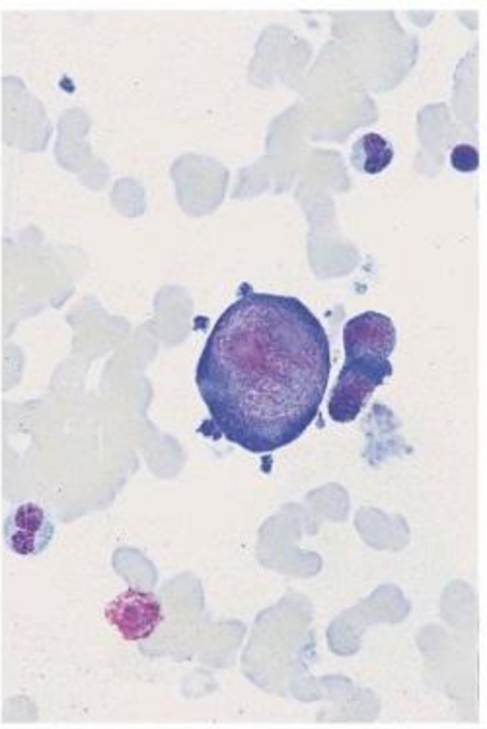
A bone marrow aspirate smear is shown. Which of the following is the most
likely causal organism of the patient's anemia?
Question 15

Question 16

Question 17

Question 18
Question 19

Question 20

Question 21

Question 22
A 57-year old man with asthma comes to the emergency department 30 minutes after the onset
of severe shortness of breath and left-sided
chest discomfort while cross-country Skiing. He has no history of similar
symptoms. He also has major depressive disorder and hypertension
Current medications include albuterol, fluticasone inhaler, fluoxetine, and
lisinopril His temperature is 37°C (98.6°F), pulse is 110/min, respirations
are 30/min, and blood pressure is 130/70 mm Hg. On auscultation,
wheezes are heard that are more prominent on the right side than on the
left. Cardiac examination shows normal heart sounds with no murmurs. A
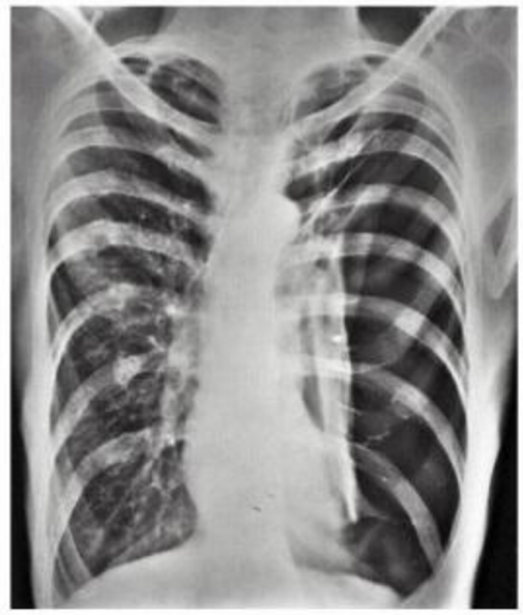
chest x-ray is shown. Which of the following conditions is the most likely
cause of this patient's acute dyspnea?
Question 23

Question 24

Question 25
A healthy 54-year-old woman undergoes an exercise stress test. During the moderate phase of the exercise, her pulse is 140/min respirations are 25/min, and blood pressure is 130/90 mm Hg Which of the following is the relative proportion of coronary oxygen delivery during the rest and during the exercise times?| Rest | Moderate Exercise | |
|---|---|---|
| Systolic > Diastolic | Systolic > Diastolic | |
| Systolic > Diastolic | Systolic < Diastolic | |
| Systolic < Diastolic | Systolic > Diastolic | |
| Systolic < Diastolic | Systolic < Diastolic | |
| Systolic = Diastolic | Systolic > Diastolic | |
| Systolic = Diastolic | Systolic < Diastolic |
Question 26
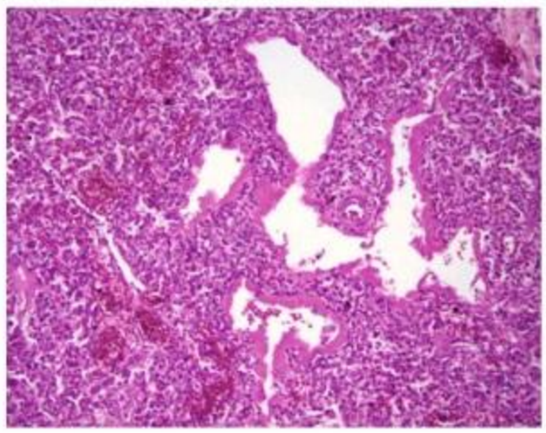
A male newborn delivered at 32 weeks' gestation dies of respiratory failure at the age of 2 days. A photomicrograph of lung tissue obtained at autopsy is shown. This patient most likely had a deficiency of which of the following substances?
Question 27
Question 28

Question 29

Question 30
Question 31
Question 32

Question 33

Question 34

Question 35

Question 36

Question 37

Question 38
Question 39
A 45-year-old man with a long history of severe rheumatoid arthritis is being treated aggressively with gold salts. Over the past 6 weeks, he has gained 6.8 kg (15 lb) and has had progressive ankle swelling that has made it difficult to put on his shoes in the morning. He has generalized edema. Serum creatinine concentration is 1.0 g/dL. Urinalysis shows 4+ protein, numerous hyaline casts, and oval fat bodies, but no red cell casts. Urinary protein excretion is 8.4 g/24 h. The electron micrograph shows a glomerular capillary loop obtained on biopsy. Which of the following is the most likely diagnosis?
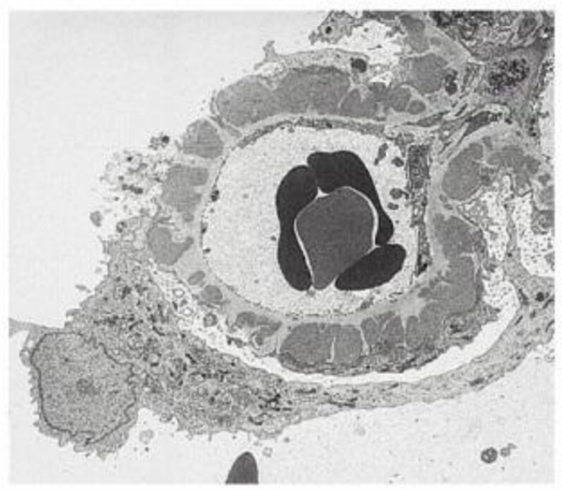
Crescentic glomerulonephritis
Focal segmental glomerulosclerosis
Membranous nephropathy
Minimal change disease
Proliferative glomerulonephritis
Question 40
A 19-year-old man is brought to the emergency department 45 minutes after collapsing at a party. He is agitated and disoriented. His temperature 1s 39.7°C (103 .5°F), pulse is 138/min, respirations are 28/min, and blood pressure is 160/102 mm Hg Physical examination shows hot, flushed skin; the pupils are dilated and responsive to light Which of the following substances is the most likely cause of this patient's symptoms?Ecstasy (3 4-methylenedioxymethamphetamine)
Ethanol
Heroin
Ketamine
LSD
Question 41
A 25-year-old woman comes to the physician because of increasingly severe pain of the night hip during the past week. She runs 5 miles daily and recently changed her route because of construction. She now runs on uneven ground rather than pavement Range of motion of the hip is full The pain 1s exacerbated by flexion and internal rotation of the hip and by direct palpation over the lateral aspect of the hip. Which of the following structures is most likely involved in her condition?Ansenne bursa
Ischial bursa
Psoas bursa
Sacroikac joint
Sciatic nerve
Trochanteric bursa
Question 42
A 4-year-old boy has progressive muscle weakness and markedly increased serum creatine kinase activity. Additional laboratory studies show deletion of the gene for dystrophin. Which of the following patterns of inheritance should be explained during a counseling session?Autosomal dominant
Autosomal recessive
Mitochondrial
X-inked dominant
X-linked recessive
Question 43
A 20-year-old man comes to the physician because of a 2-month history of persistent pain in his right knee. He is a college football player Physical examination shows a stable right knee with tendemess to palpation. An x-ray of the right knee is shown the arrow indicates an abnormality. The most likely cause of this patient's pain is ossification of which of the following structures?
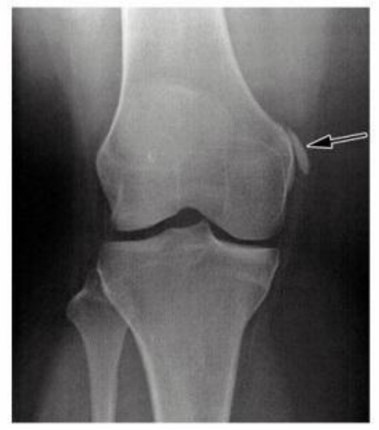
Lateral collateral ligament
Lateral meniscus
Medial collateral ligament
Medial meniscus
Tendon of adductor magnus
Question 44
Two programs for the treatment of patients with newly detected hypercholesterolemia were tried in a community. Program A was used in one district of the community, and Program B was used in another. After four years, 40% of the 110 patients on Program A and 53% of the 95 patients on Program B had been successfully treated for hypercholesterolemia. The p-value for the difference was 0.3 Based on these data, the health officials decide not to change to program B in the first district. Which of the following best explains this decision?They attributed the difference in success rates to chance alone
They distinguished between statistical significance and clinical significance
They felt the power was too high to justify a decision in favor of Program B
They felt the p-value was too small to justify a decision in favor of Program B
Question 45
A 29-year-old woman comes to the physician because of a 1-week history of nausea and vomiting in the momings. Her last menstrual period was 8 weeks ago. Current medications include an oral contraceptive, she has not missed any doses during the past 2 years Four months ago, she began taking an herbal preparation that was given to her by a fnend, but she cannot remember the name of the herb. Physical examination shows a uterus consistent in size with an 8-week gestation. A urine pregnancy test result is positive. This patient has most likely been taking which of the following herbal preparations?Echinacea
Ginkgo biloba
Ginseng
Saw palmetto
St John's wort
Question 46
A 10-year-old boy is brought to the physician because of increased urination and progressive fatigue during the past 2 weeks. Vital signs are normal except for a pulse of 120/min. Physical examination shows dry mucous membranes and dry skin. His fasting serum glucose concentration 1s 350 mg/dL. Which of the following mechanisms best explains the increased urine output in this patient?Decreased synthesis and release of ADH (vasopressin)
Disruption of the transverse gradient in the loop of Henle
Increased glomerular filtration rate
Increased osmolanty in the tubular lumen
Inhibition of the sodium-glucose transporter in the proximal tubule
Question 47
A 42-year-old man needs a kidney allograft. His lymphocytes are examined by the mixed lymphocyte reaction with killed stimulator cells from himself and from each of 5 prospective donors. A donor with which of the following thymidine incorporation values (cpm) will be most compatible? (The patient has a thymidine incorporation value of 425/cpm )312
1542
2505
15,389
27,482
Question 48
A 40-year-old man with hepatitis C is admitted to the hospital because of progressive confusion and disorientation during the past 3 days. He does not drink alcohol or use illicit drugs. He takes no medications. On arrival, the patient is agitated and confused Physical examination shows asterixis Treatment with lactulose improves his confusion. Which of the following effects of lactulose in the colon is the most likely cause of this patient's improved mental status?Aacdification causing increased ammonium ion absorption
Acdification causing increased ammonium ion excretion
Alkalization causing increased ammonia absorption
Alkalization causing increased ammonia excretion
Question 49
A 72-year-old woman comes to the physician because of an 8-month history of burning chest pain and a bitter taste in her mouth; both symptoms occur at night when she lies down. The pain does not radiate and is not associated with shortness of breath. Physical examination shows no abnormalities. Which of the following is most likely to be associated with her symptoms?Atrophic gastritis
Helicobacter pylon infection
Impaired relaxation of the lower esophageal sphincter
Metaplasia of the esophageal epithelium
Spasm of the esophageal smooth muscle
Question 50